ICH GCP E6 R3 Good Clinical Practice training
Get your accredited ICH GCP certification covering Annex 1 and 2, approved by TransCelerate and recognized by top sponsors and CROs.
⭐⭐⭐⭐⭐ 4.8 — 94 verified reviews 6,000+ certified professionals
Expert author: Adam Williams
8hs
Average study time
€97
Price
English
LANGUAGE
Final Exam
YES
Professionals from these organisations have completed our training



Certification
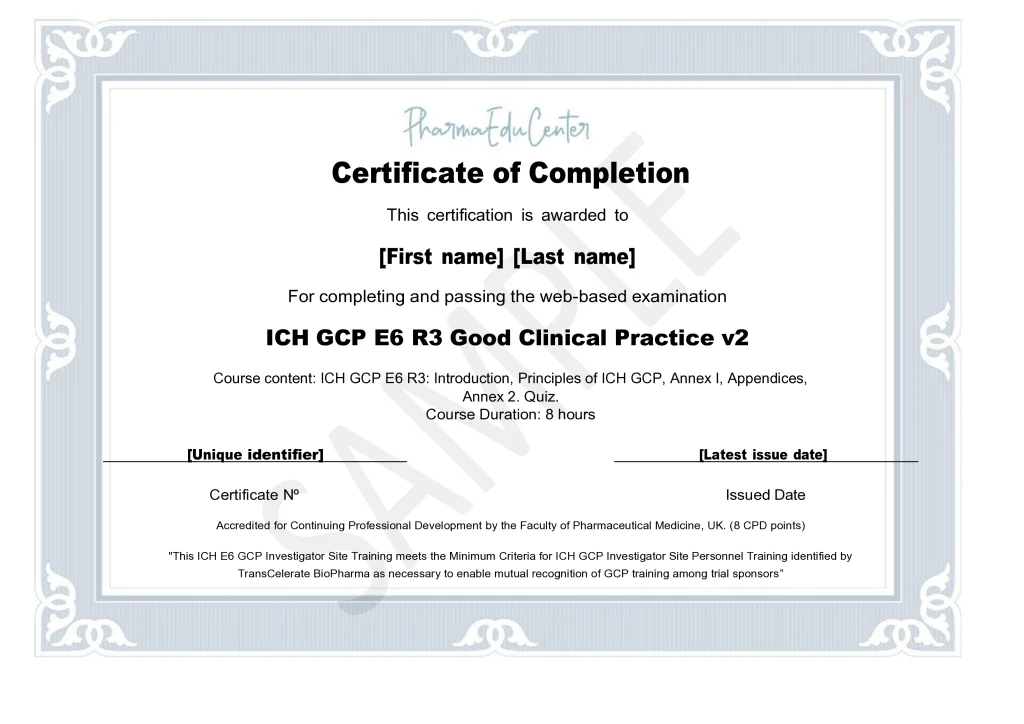
Upon completion, you will receive an official, CPD-accredited ICH GCP E6 R3 certification, downloadable and shareable on LinkedIn, and fully qualifying you to work on international clinical trials globally.
Description
This ICH GCP R3 online course covers all sections specified by the ICH GCP E6 R3 guideline, including Annex 1 and 2, and meets all training criteria for you to participate in international clinical trials.
This accredited ICH GCP certification meets the Minimum Criteria for ICH GCP Investigator Site Personnel Training identified by TransCelerate BioPharma, Inc., enabling mutual recognition among trial sponsors. Accredited by the Faculty of Pharmaceutical Medicine (UK) and worth 8 CPD points.
This course is designed for clinical research professionals who need a recognized, audit-ready certification.
Learn at your own pace through interactive content and real-world case studies. Pass the final exam with 80% or above and receive your official GCP certificate instantly. Earn 8 CPD points accredited by the Faculty of Pharmaceutical Medicine (UK).
What you will learn?
Upon completion of this course, you will be able to:
- Understand the full GCP framework: Learn the core ICH GCP principles and the responsibilities of every party in a clinical trial: investigators, sponsors, monitors, and IRBs/IECs.
- Know exactly what documents you need: Master the essential records required to run a compliant trial, including the Investigator Brochure and all supporting documentation.
- Apply the new Annex 2 requirements with confidence: Understand its scope, how it integrates with Annex 1, and how to use Quality by Design (QbD) and risk-based approaches in your specific trial context.
- Handle modern trial settings correctly: Apply GCP principles to remote, hybrid, and pragmatic trials, including informed consent, investigational product management, and digital health technologies (DHTs).
- Manage data risks like a pro: Identify and mitigate cybersecurity vulnerabilities, missing data, and confidentiality risks using a practical, risk-based approach.
- Be audit-ready from day one: Work through real case studies and simulations that prepare you to apply Annex 2 guidance proportionately, exactly what inspectors expect to see.
Who should enrol?
- Persons expecting to start a career in clinical research within pharmaceutical companies or CROs, as CRAs/monitors, clinical leads, project managers, etc.
- Experienced clinical research staff requiring a GCP certification for CRAs, monitors, clinical leads, and project managers, with full documentation for sponsor and audit requirements.
- New or experienced physicians, investigators, and clinical research staff requiring a documented Good Clinical Practice Certification.
- Staff from University Hospitals, research institutes, and research nurses
- Ethics committee members
Curriculum
- What is ICH GCP?
- GCP Guideline Scope
- ICH-GCP E6 R3 Guideline Structure
- The need for the ICH GCP E6 R3 guideline
- Principles of ICH GCP
- What is the purpose of an ethics committee?
- Submission and Communication
- Responsibilities
- Composition, Functions, and Operations
- Procedures
- Records
- Participant’s protection
- General considerations
- Qualifications & Training
- Responsibilities and Resources
- Communication with IRB/IEC
- Compliance with Protocol
- Premature Termination or Suspension of a Trial
- Participant Medical Care and Safety Reporting
- Informed Consent of Trial Participants
- End of Participation in a Clinical Trial
- Investigational Product Management
- Randomization Procedures and Unblinding
- Records
- Documentation and Reporting
- The investigator’s role in risk management
- General considerations
- Trial Design
- Resources
- Allocation of Activities
- Qualification and Training
- Financing
- Agreements
- Investigator Selection
- Communication with IRB/IEC and
- Regulatory Authority(ies)
- Sponsor Oversight
- Quality management
- Quality Assurance and Quality Control
- Monitoring
- Noncompliance
- Safety Assessment and Reporting
- Insurance / Indemnification / Compensation to Participants and Investigators
- Investigational product
- Use of Technology
- Data and Records
- Reports
- Study Close-Out
- Data processing and storage (GDPR)
- Data Governance and Data Integrity
- Safeguard Blinding in Data Governance
- Data Life Cycle Elements
- Computerised Systems
- Appendices: General considerations
- General Considerations
- Contents of the Investigator’s Brochure
- Clinical Trial Protocol and Protocol Amendments
- Essential Records
- Introduction
- Institutional Review Board / Independent Ethics Committee (IRB/IEC)
- Communication with IRB/IEC
- Informed Consent Considerations
- Investigational Product Management
- Investigator Oversight
- Safety Assessment and Reporting
- Engagement and Communication
- Protocol and Trial Design
- Communication with IRB/IEC
- Access to and use of RWD
- Data Considerations
- Investigational Product Management
- Privacy and Confidentiality Considerations
- Sponsor Oversight
- Safety Assessment and Reporting
- New Glossary
- Advisory and regulatory bodies
- Important laws
- USA legislation
- EU legislation
- Japan legislation
- UK legislation
Reviews
⭐⭐⭐⭐⭐ What 6,000+ certified professionals say
FAQ: Good Clinical Practice certification and Good Clinical Practice training program
Does this Good Clinical Practice certification cover the latest ICH E6 (R3) updates?
Yes, our Good Clinical Practice certification is fully updated to include ICH E6 (R3), ensuring you stay compliant with the latest regulatory changes.
Who is this Good clinical practice training designed for?
This Good clinical practice training is designed for life science professionals, including CRAs, Investigators, and Sponsors, who need a recognized certification that meets TransCelerate criteria.
Is the Good Clinical Practice certification accepted globally?
Absolutely. Our certification follows the harmonized ICH guidelines, making it globally accepted for clinical research professionals in the US, EU, and beyond.
How do I know which GCP training should I take?
- ICH GCP E6 R3 Good Clinical Practice training: is suitable to train clinical research professionals (those working in the Pharmaceutical Industry and CROs, as for example, CRAs/Monitors) that need a more comprehensive knowledge of ICH GCP. This GCP training is also ideal for people just starting or willing to start working in the Pharmaceutical industry, CROs or Clinical Sites, as it provides comprehensive and practical knowledge of the ICH GCP Guideline.
- ICH GCP E6 R3 Good Clinical Practice training for investigators and site personnel : is suitable to train clinical investigators and site personnel (in English and Spanish, respectively) on the fundamentals of GCP and how to apply them practically in the research setting. It is also ideal as a GCP refresher, as it meets the minimum criteria for ICH GCP Investigator Site Personnel Training identified by TransCelerate BioPharma, Inc. as necessary to enable mutual recognition of GCP training.
How long is the ICH GCP certification course?
This will depend on the course; nevertheless, learners may complete the modules at their own pace.
GCP training for investigators will approximately take around 2.5 hours to complete, as it is mainly focused on investigators’ responsibilities.
The full GCP course will take around 8 hours to complete.
How long is the GCP certificate valid?
How long is GCP training valid? This is a recurring question. Nevertheless, there is no uniform standard regarding how frequently GCP training should occur. However, regulatory authorities and auditors/inspectors usually require Good Clinical Practice training to be refreshed every 3 years. Please check your country’s regulations.
A quiz is also required in order to obtain the Good Clinical Practice Certification. Usually, the passing score is greater than or equal to 80%.
Are PharmaEduCenter GCP courses mutually recognized by TransCelerate BioPharma?
Yes, our 3 GCP courses are mutually recognized by TransCelerate BioPharma. You could review each course in detail on the COURSE page.
Do I get a certificate?
Yes. When you complete an ICH GCP training with PharmaEduCenter, you will receive your official GCP R3 certificate electronically, which you can print and share with sponsors and CROs immediately.
Is there an examination?
Yes, at the end of each GCP course there is a quiz you will need to pass in order to demonstrate you have acquired the knowledge and are appropriately trained. The passing score is greater than or equal to 80%.
Will your GCP training help me get a job?
Although we cannot guarantee you a job if you enroll in our GCP courses, we believe that by doing so, you are providing yourself with a great opportunity to advance in your career by expanding your knowledge and skill set and staying current with industry developments. Furthermore, upon course completion, you will have the option to print the GCP course certificate, which includes all the reviewed topics.
You should include your GCP training in your work portfolio to demonstrate your knowledge to prospective/current employers.
Do I get a discount if I buy more than one course?
If you sign up for our newsletter, you will see discounts being sent out periodically for single users.
We offer discounts for more than five accounts, so please get in touch with us to discuss a discount if you need to buy a course for multiple users.
Can I purchase a corporate license for a group of people?
Yes, please contact us to discuss your team needs.
How do I purchase a course?
Select a course and purchase it. You can pay online via our secure Stripe’s payment gateway, using your preferred card, at no extra cost. The system will automatically create you an account, and you will be able to start your training.
How do I use a discount code?
If you have a discount code, you must complete the course registration process as usual. Then, when you get to the screen where you have to enter your information and make payment, there will be a field where you can enter a discount code, if any. If the code worked, the course’s price will be updated to reflect the new discounted price.
Then, proceed to sign up as usual, entering all of your information.
What does it mean that I can take the course at my own pace?
It means that it is flexible enough to allow you to start and stop from any device whenever you like, and the system will automatically save your progress. To support the lifelong learning of our researchers, we provide lifetime access to our course resources.
Will there be a record of my completion of your GCP course?
Yes, we keep track of all of our users and the dates on which they took our course. You, or your employer, may contact us at any time to confirm the validity of your certificate.
Do you have a refund policy?
We want you to be completely satisfied with your course; therefore, we offer a 30-day money-back guarantee if you are not 100% satisfied.
To request a refund, you should email us at contact@pharmaeducenter.com with proof of purchase and evidence of the course not being as advertised or any issues you have accessing or completing your course.
Please note you must not complete the course or print your certificate in order to make a valid refund claim.

This course includes:
 Free Clinical Trials Glossary
 Official ICH GCP certification
 Lifetime access
 Automated progress tracking
 Discounts for teams
 30-day money-back guarantee
100% Secure Payment 

30-day money-back guarantee: Try the full course risk-free. If you’re not satisfied before completing it, we’ll refund you, no questions asked.