Good documentation practice training
Gain practical, regulation-aligned skills and real-world examples you can apply immediately in pharma, clinical research, and QA roles.
⭐⭐⭐⭐⭐ 4.8 — 94 verified reviews 6,000+ certified professionals
Expert author: Adam Williams
4hs
Average study time
€97
Price
English
LANGUAGE
Yes
Final Exam
Professionals from these organisations have completed our training
Certification
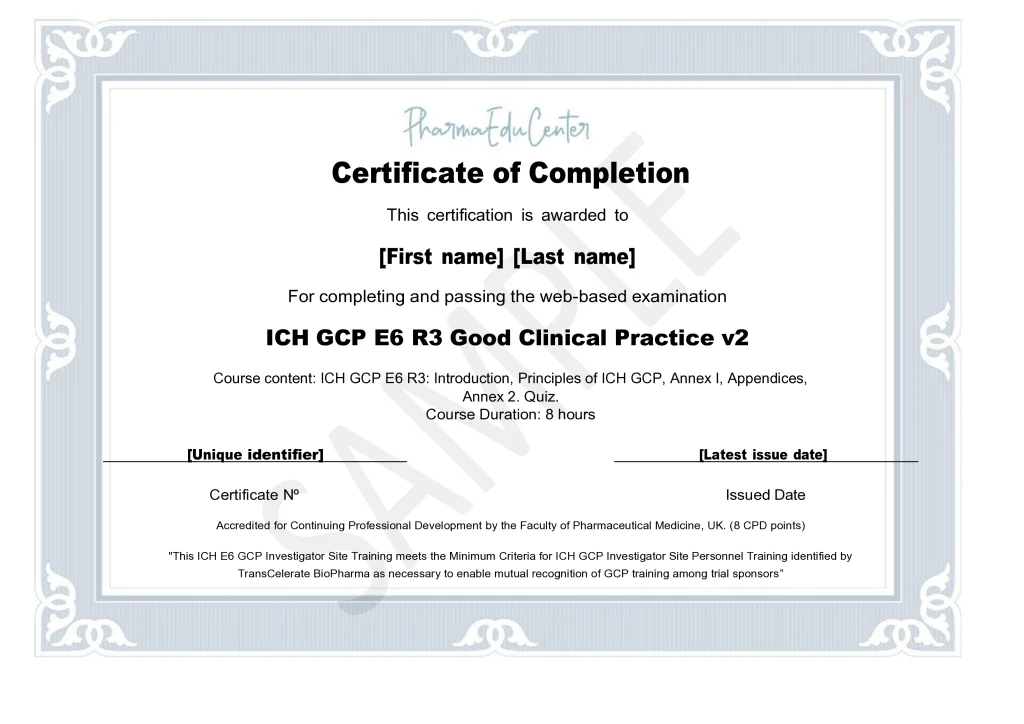
Upon completion, you will receive an official, CPD-accredited ICH GCP E6 R3 certification, downloadable and shareable on LinkedIn, and fully qualifying you to work on international clinical trials globally.
Description
The objective of this Good Documentation Practice training is to equip life sciences professionals with comprehensive knowledge of GDocP principles, providing individuals and organizations with an official certification that is widely accepted by pharmaceutical companies, CROs, regulatory bodies, and quality auditors worldwide. This Good Documentation Practice training course covers all essential documentation requirements specified by GMP regulations and meets training requirements for personnel involved in pharmaceutical manufacturing, clinical trials, and quality operations. The course provides practical guidance on applying good documentation practices and maintaining data integrity in your daily work.You will learn how to implement robust documentation systems and ensure data integrity compliance at your own pace, using interactive content and real-world examples from regulatory inspections. You will obtain a Good Documentation Practice Certification after passing the test with a score of 80%. This Good Documentation Practice training aligns with ICH GCP E6 R3 requirements and global regulatory standards, making it suitable for professionals working across international markets.
What you will learn?
Upon completion of this Good Documentation Practice and Data Integrity training course, you will be able to:
- Define data integrity and explain the data integrity definition according to global regulatory standards
- Understand what data integrity means in pharmaceutical manufacturing, clinical research, and quality operations
- Explain what is good documentation practice and the good documentation practice definition as the foundation of GMP compliance
- Apply good documentation practice examples from regulatory inspections to your daily work activities
- Navigate global regulatory requirements including MHRA guidance, FDA expectations, and EMA regulations for data integrity
- Identify and categorize essential records required throughout the product lifecycle in GMP environments
- Define what ALCOA stands for and explain each element: Attributable, Legible, Contemporaneous, Original, and Accurate
- Apply the extended ALCOA++ framework including Complete, Consistent, Enduring, and Available principles to all documentation
- Comprehend the data integrity meaning throughout the complete data lifecycle from creation through archiving and retirement
- Establish data governance frameworks that ensure what data integrity means is understood across your organization
- Explain what metadata is and why it is critical for maintaining data integrity in computerized systems
- Evaluate electronic and paper documentation against ALCOA++ criteria using practical good documentation practice examples
- Conduct effective data integrity checks using risk-based quality management approaches
- Identify, investigate, and document data integrity issues and implement appropriate corrective and preventive actions
- Perform impact assessments to determine the effects of data integrity breaches on study results, product quality, and patient safety
- Apply good documentation practice principles to create compliant records that meet regulatory inspection standards
- Implement what is good documentation practice in your day-to-day operations to strengthen organizational quality and compliance
Who should enrol?
This course is perfect for professionals working in:
Individual Professionals:
- Clinical Research Associates (CRAs), Study Coordinators, and Site Personnel
- Clinical Data Management and Clinical Operations professionals
- Quality Assurance, Quality Control, and Compliance Officers
- Regulatory Affairs Specialists and Pharmacovigilance professionals
- Manufacturing, Laboratory, and Operations personnel in GMP environments
- Anyone starting or advancing a career in pharmaceutical or clinical research
Organizations & Teams:
- Pharmaceutical and biotech companies ensuring GMP compliance across operations
- Contract Research Organizations (CROs) and clinical trial sites
- Medical device manufacturers and research institutions
- Quality Assurance departments preparing for regulatory inspections
- Clinical Data Management teams implementing data integrity standards
- Organizations seeking to reduce audit findings and strengthen documentation systems
Curriculum
- Intro to Good Documentation Practice
- What does data integrity mean?
- Global guidelines and regulations for data integrity
- MHRA Data Integrity Principles and guidance
- Good Documentation on Practice
- GDocP in GMP
- Essential records for pharmaceutical Clinical Trials
- Data
- Understanding the complete data lifecycle
- Data governance frameworks and accountability
- Technology role
- What metadata is, its types, and why it matters
- Quality in clinical trials
- Data integrity checks
- Management of data integrity issues and CAPA
- Effects of data integrity on study results
- Glossary
Reviews
⭐⭐⭐⭐⭐ What 6,000+ certified professionals say
FAQ: about Good Documentation Practice
Good Documentation Practice (GDP) is the essential set of standards and principles governing how documents, records, and data should be created, maintained, and managed across the entire product lifecycle. It ensures that every action is accurately recorded, attributable, legible, and available for auditing, making it the bedrock of regulatory compliance.
Data Integrity refers to the completeness, consistency, and accuracy of data throughout its lifecycle. It means the data must be trustworthy and reliably reflect the true state of the record. Maintaining high Data Integrity is crucial because regulatory bodies (like the FDA and EMA) rely on it entirely for approving product quality and patient safety.
GDP is the method used to achieve the goal of Data Integrity. By following precise Good Documentation Practice rules (e.g., proper error correction, contemporaneous recording, permanent storage), you ensure the data remains accurate, complete, and trustworthy (ALCOA+), thus achieving true Data Integrity.
Data Integrity means the data is true, complete, and trustworthy throughout its lifecycle (e.g., the temperature log wasn’t altered). Data Quality means the data is accurate for its intended purpose (e.g., the thermometer was calibrated correctly). While related, Data Integrity focuses on the trustworthiness and security of the record, whereas quality focuses on the accuracy and relevance of the content.
Anyone who records, reviews, or relies on regulated data needs Good Documentation Practice training. This includes manufacturing operators, QC/QA personnel, laboratory analysts, clinical trial staff, and IT professionals working with electronic systems. It is mandatory for compliance in GMP, GLP, and GCP environments.
Our Good Documentation Practice training focuses heavily on the internationally recognized ALCOA+ principles: Attributable, Legible, Contemporaneous, Original, Accurate, plus the added criteria of complete, consistent, and enduring. Mastering these principles is central to maintaining regulatory standards.
Yes. Modern Good Documentation Practice must address electronic systems. We cover the specific challenges of electronic records, system validation, audit trails, and the specific Data Integrity requirements for CFR Part 11 compliance (electronic signatures and records).
If you sign up for our newsletter, you will see discounts being sent out periodically for single users.
We offer discounts for more than five accounts, so please get in touch with us to discuss a discount if you need to buy a course for multiple users.
Yes, please contact us to discuss your team needs.
Select a course and purchase it. You can pay online via our secure Stripe payment gateway, using your preferred card, at no extra cost. The system will automatically create you an account, and you will be able to start your training.
If you have a discount code, you must complete the course registration process as usual. Then, when you get to the screen where you have to enter your information and make payment, there will be a field where you can enter a discount code, if any. If the code worked, the course’s price will be updated to reflect the new discounted price.
Then, proceed to sign up as usual, entering all of your information.
It means that it is flexible enough to allow you to start and stop from any device whenever you like, and the system will automatically save your progress. To support the lifelong learning of our researchers, we provide lifetime access to our course resources.
Yes, we keep track of all of our users and the dates on which they took our course. You, or your employer, may contact us at any time to confirm the validity of your certificate.
We want you to be completely satisfied with your course; therefore, we offer a 30-day money-back guarantee if you are not 100% satisfied.
To request a refund, you should email us at contact@pharmaeducenter.com with proof of purchase and evidence of the course not being as advertised or any issues you have accessing or completing your course.
Please note you must not complete the course or print your certificate in order to make a valid refund claim.

This course includes:
 Official certification
 Lifetime access
 Automated progress tracking
 Discounts for teams
 30-day money-back guarantee
100% Secure Payment 

30-day money-back guarantee: Try the full course risk-free. If you’re not satisfied before completing it, we’ll refund you, no questions asked.